Peter Sculthorpe, the great Tasmanian born Australian
composer, is someone whose music I have listened to with ever-increasing
interest since my first encounter on an early Kronos Quartet LP.
His is a multi-faceted art: aboriginal music and myth, and the
nature mysticism/folk naivete of early Mahler. He also draws on
Pacific Rim influences - no doubt encouraged not only by his homeland's
geographical and cultural legacy but also by his studies in Britain
with Edmund Rubbra. It is a potent, indeed magnetic, and generally
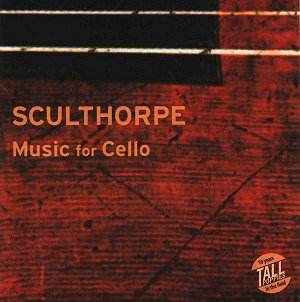
accessible brew. This disc, one in a series celebrating Tall Poppies’
tenth anniversary, offers us an overview of Sculthorpe's output
for cello. It gives an excellent insight into where he is coming
from, artistically speaking. It also has the advantage of featuring
one of the composer’s favourite instruments.
The disc begins with the single movement Sonata
which makes clear the Mahlerian influence. That said, there is
never, here as in any Sculthorpe, any danger of his always supremely
lucid artistic vision being clouded by the extreme pathos or,
alternatively, the bombast that afflicts some of Mahler’s work.
Sculthorpe's ideal conception of Mahler, very much like my own,
is that of the child wandering carefree in Alpine meadows (see
the second volume of the Sculthorpe string quartets, for more
specific references). The following Requiem draws heavily
on plainchant and distils deep emotional currents. There are echoes
here of James MacMillan or even John Tavener's more austere inspirations,
e.g. Eternal Memory. In contrast, Djilile is based
on an aboriginal chant about a "whistling duck on a billabong
(watering hole)". It has appeared in several guises - I was already
familiar with the solo piano version but the cello certainly adds
something extra. It is a subdued but truly haunting piece of music
and is typical of Sculthorpe in that, without resort to any histrionics
whatsoever, it perfectly captures the wild strangeness of the
Australian outback.
The Tailitnama Song, again an aboriginal
inspiration, appears here in two versions, one with piano and
one without. Again it is rooted in the natural surroundings which
generated it and is equally poetic in either incarnation. The
song it is based on concerns "the glowing of the mountains" and
"the coming of the dawn" which should give the uninitiated a good
idea of what Sculthorpe's muse is driven by. Nature is writ large
but not, in any sense, in a twee or sanitised way. If you are
looking for comparisons, in intensity rather than style, Nielsen,
Sibelius, Tveitt and, unsurprisingly, Lilburn spring to mind.
However, Sculthorpe is very much more overtly tuned in to the
Oriental, southern hemisphere, Pacific Rim mindset. Threnody
is based on the orchestral work Kakadu (after the national
park) and is dedicated to the memory of conductor Stuart Challender.
The composer has written many works which function as laments
and, as with his nature-painting, he reveals a great gift for
doing so.
Into the Dreaming used to be called Cello
Dreaming but now exists in alternative versions for other
instruments including one for guitar (recorded by John Williams
for Sony). Again it is a memorial piece for a dead friend but
is also inspired by the awesome landscapes of the Uluru (Ayers
Rock) national park. Again it cuts to the craw emotionally without
ever descending to sentimentality. Parting is an arrangement
of a song setting of Heine. It is highly appropriate that the
lyrical cello is the singer here (the texts appear in the booklet).
This is yet another tribute to a life cut short prematurely (the
journalist Andrew Olle). The disc concludes with From Saibai,
a truncated version of the excellent clarinet work Songs of
Sea and Sky (also available on Tall Poppies). It typifies
Sculthorpe's recent fascination with the music of the peoples
of the Torres Strait (the narrow seaway between northern Australia
and Papua New Guinea), which has also inspired some of the later
string quartets (Island Dreaming etc.). Like virtually
everything on this disc, and in any other Sculthorpe, it sings
a joyous yet realistic, accessible yet profound, song of the elements,
of the natural world and the people who live in close proximity
to it.
David Pereira proves, as on other Tall Poppies
recitals, that he is a world class cellist, in this case ably
accompanied by Ian Munro. Belinda Webster's vision as a recording
engineer is among the most astute in the world. This CD, a 70th
birthday tribute (in 1999) to Peter Sculthorpe, is among the most
satisfying of modern chamber recordings I have ever heard and
a true work of art. Recommended without reservation.
Neil Horner
Learn
more about Sculthorpe here
 David Pereira, cello