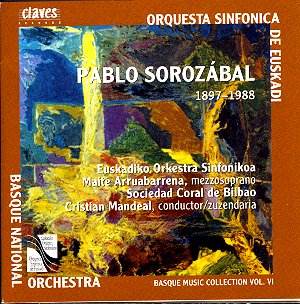
Claves has initiated a series of discs devoted
to the Basque music tradition, of which this is the latest installment.
Sorozábal was born in San Sebastián in 1897 where
he studied violin and harmony. He was taken on by the Madrid Philharmonic
as a violinist in 1919 but left the following year for post-War
Leipzig where he studied counterpoint with Stephan Krehl and conducting
with the venerable Hans Sitt (who had himself been a violinist
of distinction). The first choral compositions soon followed and
it was in Leipzig that Sorozábal first flourished as a
composer. His big hit came back in Spain in 1931 with the operetta
Katiuska and thenceforward his direction was set. Twenty-four
operettas followed and some film music. Once having reached a
position of eminence, and presumably a degree of financial security,
he returned more and more to instrumental composition. If I knew
his name at all it was from Zarzuela and the recordings here do
show that whatever else he may have written his instrumental music
retains a freshness and vocalized impress that was indissolubly
part of his musical style. He wrote with genuine lyricism but
also lightly. Even in a piece such as Gernika (Guernica
to non-Basques) his setting, albeit one written much later than
the tragedy (unlike say Lidice or the Leningrad Symphony,
to take the two most obvious examples) evokes little visceral
feeling.
The works here divide nicely between accompanied
choral, lieder and orchestral. As can be seen from the head-note
a number were expanded for choir and orchestra many years after
their first incarnation. All are tuneful, and well scored, idiomatically
written, especially for choral or solo voices. Euskalerria
was a hit song for the composer and this is a choral variant with
Basque lyrics – a popular, very late nineteenth century affair.
The Suite Vasca was one of the products of his Leipzig
sojourn and show that the characteristics that one finds in his
later work were audible from the start: conventional harmony,
breezily avuncular, a fine ear for choral writing, predilection
for late nineteenth century development. It’s only in the final
Witches’ Song that an element of
individuality seeps out. It reminded me very slightly of Janáček’s
Moravian folk settings. Gernika, referred to above,
was written in Madrid in 1966 but this revision dates from a decade
later. Claves tend authoritatively to print the revision date
when the original would make the compositional process clearer.
His original title was Gernika, Basque Funeral March. Guernica
is very close to Bilbao, whose orchestra plays so adeptly on this
disc. He dedicated the work to his mother. This revision has lyrics
by poet Nemesio Etxaniz. Opening with funereal drum-taps but also
a swirlingly, noble theme the work is as much affirmatory as pessimistic-tragic.
The choral sopranos really have a big extension to make at the
top of their compass and whilst there’s real strain there’s a
sense of striving for freedom too. Again this is no Lidice,
no Mahlerian death rattle. This is tragedy recollected with a
degree of, if not recollection, at least distance. I actually
prefer his writing for orchestra alone. The two Apuntes vascos
are full of harp and shimmer - his impressionistic self. Unlike
many of his compatriots he went to Germany not France but elements
of French impressionism are certainly there in his orchestration.
The Lieder are accompanied by orchestra in this version and sung
with grandiloquent expressivity by Maite Arruabarrena. They were
written in Leipzig in 1931 and are Basque translations of Heine.
Nevertheless this is pretty light and snappy stuff, full of pleasant
harmonies (nothing more) and Basque dance rhythms. I doubt Heine’s
poetry has ever sounded so unadulteratedly happy. The Variaciones
sinfónicas again is a Leipzig work of 1927. He apparently
considered it the equivalent of a symphony. It’s an attractive
suite that occasionally strikes a deeper note. He cultivates somewhat
antique sonorities, has a balletic ear in the second variation
in Zortzico rhythm but mines unusual depth in the Andante lamentabile
variation that goes beyond the merely conventional. The work’s
heart this Andante has a mini-Brucknerian amplitude – a melody
escaping over heartbeat pizzicati, full of nightmare as well.
There are piquancies in the sixth, Andantino, variation – about
as modernistically spiced as Sorozábal gets here. The final
variation, a long multi-partite one, is tuneful and dance like,
though hinting at some hieratic grandeur, vocalized, Iberian certainly,
with an admixture of baroque lyricism.
The performers acquit themselves well. The recording
is good but not outstanding. There’s a lack of bloom especially
in the choral pieces that rather hardens the sound. No masterpieces
here – but an intriguing avenue to explore.
Jonathan Woolf
see also review
by Chris Howell
 Maite Arruabarrena (mezzo-soprano)