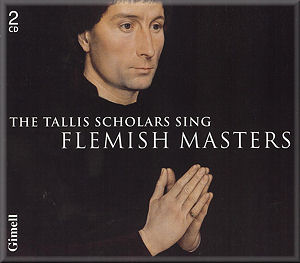
This 2 CD set re-cycles five striking masses by five
very different Flemish composers. The time-span covers a century
from 1475
(for Ockeghem’s Missa Au travail suis) to 1575
(for Lassus’ Missa Osculetur me). As those one
hundred eyars unfolded so the sense of what a mass was developed
also. In the first of these Ockeghem uses just four voices
and is not far from Josquin for whom the four-voiced mass
was perfect
chamber music. The next in line, Isaac, uses six voices, then
Brumel an amazing twelve, de Rore deploys seven voices and
finally
Lassus contributes a double choir mass (two choirs each of
eight voices) used in the late renaissance poly-choral manner.
The recordings here were made over an eight year period, all
at the Church of St. Peter and St. Paul, Salle, so that there
is a consistency of sound quality. All have been issued before
in single composer discs. I am not sure whether it is helpful
to lump all five together under the Flemish category as the
composers’ backgrounds are so different. But it does provide
a nice excuse to assemble some lovely recordings of delicious
music. That said, the composers are all linked by a commonality
of technique, even if the results differ remarkably. All are
based on pre-existing material with much contrapuntal ingenuity
creating a melodic mosaic.
The casts for these recordings are in effect a roll-call of
fine and distinguished singers. They include Tessa Bonner, Charles
Daniels, Sally Dunkley, Robert Harre-Jones, Mark Padmore, Deborah
Roberts and Ashley Stafford. I must confess that, in the past,
I have found the Tallis Scholars’ approach to music of
this period to be rather too smooth and over modulated. I have
usually preferred a more muscular approach. I seem to have mellowed,
as I found the Tallis Scholars’ style entirely apposite
to the music.
Ockeghem’s Missa Au travail suis is based on a
secular tune, either a chanson by Ockeghem himself or another
unknown composer. Ockeghem only quotes the tenor part from the
chanson. Ockeghem keeps his four voices to within quite a narrow
compass so that the result is a Mass full of low, dark textures.
The Tallis Scholars give it a rather lovely chocolaty texture.
They also relish the moments when Ockeghem thins things out,
leaving just a pair of voices.
By contrast, Isaac’s Missa De Apostolis displays
rich textures and soaring lines. It unfolds in a leisurely fashion;
Isaac misses out the Credo, whereas Ockeghem includes it. Isaac
still manages to make his mass last eight minutes longer than
Ockeghem’s example. Isaac sets the text alternim,
alternating plainchant with polyphony. The contrast helps to
emphasise the richness of the six-part writing. It is based
on plainchant for the Feast of the Apostles and was presumably
written for the court in Vienna where Isaac was employed; in
Vienna it was customary not to include the Credo as part of
the Ordinary.
Cipriano de Rore’s Missa Praeter rerum seriem seems
to date from the period 1547/48 when de Rore was employed by
Duke Ercole II d’Este of Ferrara. De Rore was an older
contemporary of Lassus and wrote the mass just ten or twenty
years before Lassus’s Missa Osculetur me. Despite
this, de Rore’s writing is firmly in the Flemish school
- worlds away from Venetian polychoral writing. It is based
on a Josquin motet; de Rore also repeatedly uses the song’s
alto part as a cantus firmus, setting as the text
Duke Ercole’s name. The textures are rich and dark, enlivened
by some nice cross rhythms.
Brumel’s astonishing Missa Et ecce terrae motus dates
from before 1520, when no-one had written a 12 part mass. He
became deservedly famous for this piece in the 16th
century. The manuscript source for the mass was copied for a
1570s performance at the Bavarian Court in which Lassus sang
Tenor 2 and the top three parts were taken by boys. Parts of
the Agnus Dei have rotted away so that any completion must be
conjectural. The part allocation is remarkable. Technically
there are three soprano parts, three alto parts, three tenor
parts and three bass parts. Only one alto part is really an
alto part. Brumel uses the other two altos and the three tenors
to cover the same tessitura, writing far-reaching parts so that
alto 2 has a range of over two octaves.
In the twelve voiced parts, Brumel runs a series of canonic
textures over an unhurried cantus firmus - based on the
Easter antiphon Et Ecce terrae motus. The result is harmonically
slow-moving and almost unadventurous, but in terms of texture
and use of canonic motifs it is dazzling - think Josquin arranged
by John Adams perhaps. This performance from the Tallis Scholars
manages to bring admirable clarity to the textures, when it
could easily be a muddy mess. Generally the cantus firmus
lines are set nicely, being highlighted against the faster-moving
canonic textures. That said, occasionally an individual voice
gets a little too much prominence.
As ever Peter Phillips directs these performances with clarity,
precision and a feel for a nicely modulated line. A great deal
of scholarship has gone into producing the music on the disc,
but when you listen you forget scholarship and simply lie back
and enjoy some fabulous music, beautifully and intelligently
sung.
Robert Hugill



















 Tallis
Scholars/Peter Phillips
Tallis
Scholars/Peter Phillips 
