Editorial Board
MusicWeb International
Founding Editor Rob Barnett Editor in Chief
John Quinn Contributing Editor Ralph Moore Webmaster
David Barker Postmaster
Jonathan Woolf MusicWeb Founder Len Mullenger
Buy
through MusicWeb for £10 postage
paid World-wide.
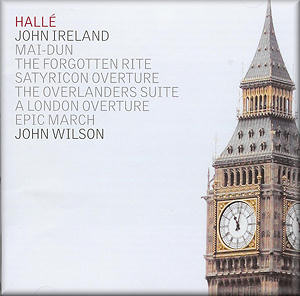
John IRELAND (1879-1962) Mai-Dun (1921) [11:04] The Forgotten Rite (1913-1918) [7:09] Satyricon Overture (1944-1946) [8:45] The Overlanders Suite (arr. Sir Charles Mackerras) (1946-1947)
[19:27] A London Overture (1936) [12:14] Epic March (1942) [8:18] The Hallé
Orchestra/John Wilson
rec. 24-25 March 2007, BBC Studio 7, New Broadcasting House, Manchester
HALLÉ CDHLL
7523[67:41]
Sound samples interpolated in the review
I was reading the sleeve-notes of this CD on a train from the
North Country down to 'The Smoke'. A lady opposite was
busy typing away on her laptop. However, I could see that something
had caught her eye. I knew that it was not me, so it had to be
the CD box! I showed it to her and asked if she knew the music
of John Ireland. She shook her head and said, “Never heard
of him, but I think the Hallé Orchestra are the best in
the world”. Although the conversation ended as quickly as
it started, it certainly gave me food for thought.
The advertising blurb on the CD cover quotes a reviewer in The
Times. It states quite categorically, “I'd rather listen
to the Hallé play English music than any other orchestra
in the world.”
So, here are two resounding shouts for the great Manchester-based
band. And if I am honest I would have to agree that this present
performance of John Ireland's orchestral music is truly superb.
I would add my voice to the above comments - with one caveat.
I have always felt that the Hallé could programme just
a little bit more British music. I have looked at their programmes
back over the last hundred years or so (see Michael Kennedy's
history of the orchestra) and although they do have a fair few
performances of British Music - both premieres and subsequent
outings- there is a definite bias towards the mainstream European
tradition (including Sibelius). More pertinently, perhaps, there
is a distinct lack of music by Manchester-based composers - both
alive and dead. It is sad that it took the City of Birmingham
Symphony Orchestra to present the orchestral music of John Foulds
to the world. However, we must not forget that John Ireland was
born in Bowden, Cheshire. This is in the catchment area of the
Hallé and the Bridgewater Hall. So they are making amends!
The present CD is a veritable feast of Ireland's orchestral
music. In fact it makes an excellent introduction to his music.
There are six works on this disc which represent different facets
and interests of the composer's achievement.
Perhaps the most important works are those associated with location
and history - Mai-Dun and TheForgotten
Rite. Much of his music was infused with evocations of place
and the people who had lived there. This was especially the case
when those places had connections with the prehistoric and had
'mystical aspects' associated with their beliefs and rituals.
He had a heightened sense of 'awareness of place': a kind
of sixth-sense.
Of all the orchestral works of John Ireland, Mai-Dun (1921)
is the one that I am least familiar with. There is no excuse for
this: it has been in my record collection for thirty-odd years.
But somehow it did not appeal to me as much as The Forgotten
Rite. Perhaps the reason for this is that it less of an impressionistic
work and more of like programme music: there is a definite tale
to tell here. Mai-Dun was Thomas Hardy's title for the great
fortifications at Maiden Castle near Dorchester. Julian Herbage
has reminded listeners that Ireland was a great fan of Hardy:
he sympathised with the author's belief in “the harshly
indifferent force that governed mankind”.
The resulting piece of music is really an aural description of
the 'strenuous life and struggles' of the folk living
in or around the castle. The opening and closing music is quite
obviously meant to depict war-like strife: it is like little else
that Ireland wrote. sample:
opening. It pushes closer to Stravinsky than it has been given
credit for. Yet the middle section is totally romantic in its
ethos. Prehistoric men and women had their affairs of the heart
too!
However, I would rather listen to this music as if it were an
abstract work. I do try to forget about prehistoric battles and
just allow the music to weave its spell. John Ireland, in his
own way, had a “strenuous life and struggles” - at
least emotionally.
Prelude: The Forgotten Rite is my favourite piece of Ireland
orchestral music. In fact it is really a tone-poem rather than
just a 'prelude'. The piece was written the year before
the start of the Great War but was not actually performed until
1917. It is the received opinion that the background to this piece
is the island of Jersey in the Channel Islands. Ireland wrote
in a programme note for the premiere that this work “evoked
the mystical aspects' and 'occult forces' of nature.
Yet it has nothing like the savagery of The Rite of Spring
or the sheer eroticism of Debussy's Prélude à
l'après-midi d'un faune. In many ways, Ireland is able
to convey his sense of time and place using the palette of romantic
music as well as the techniques of impressionism. Listen for the
wonderful flute and oboe solos and the haunting evocation of the
horns of Elfland. sample:
opening
The second group of pieces are the two fine overtures- one celebrating
the sights and sounds of London and the other being an appeal
to the “carefree adventures and escapades of three Roman
youths” as presented in the great poem, Satyricon
by Petronius. The Satyricon Overture began life as a wedding
present for the critic Julian Herbage and his wife Anna. John
Ireland was at that time enthusiastic about the 'recital of
lecherous happenings' that the Roman author had described.
Perhaps he was sympathetic to the boy Giton? However two things
need to be said. Firstly this is joyous and capricious music that
is full of life and celebrations. It is not in any way 'confessional'
music. sample:
opening And secondly, the exploits alluded to by the composer
are tame fare when compared to the later film by Fellini! Lookout
for the clarinet solo, which is a kind of leitmotif for Giton.
It was the composer's final orchestral score and was first
performed by Sir Henry Wood at a Promenade concert in 18 August
1946.
I love the London Overture (1936). For me it has the same
ability to create an 'impression' that Whistler's
paintings of Conan Doyle's Sherlock Holmes does. The work
was based on an earlier Comedy
Overture which had been written for the 1934 National
Brass Band Competition at Crystal Palace. The oft-quoted 'onomatopoeic'
theme of “Dilly - Piccadilly” does nothing to lessen
the impact of this work. sample:
opening Perhaps my favourite part of this piece is the delicious
'nocturne' section. It is surely evocative of the Thames
by night or a late evening stroll with one's lover in a London
Square. extract
Yet, it was actually a lament for a personal friend of the composer.
But all sadness is banished and the work ends positively.
I am not the first person to mention this, but this Overture can
surely be seen as a pendant to the great London Pieces
for piano.
The third facet presented in this recording is the only essay
that Ireland made into film music. The Overlanders was
made just after the end of the war in 1946. It was an Ealing Studios
production which starred Chips Rafferty and was produced by Sir
Michael Balcon. The story is set in the Northern Territories of
Australia in 1942. At that time the Japanese were poised to invade
Australia: people were evacuating and were burning everything
in a 'scorched earth policy. There were over one million herd
of cattle grazing there and they would have fallen into the hands
of the enemy. So, rather than slaughter and burn them, the film
tells of the drover who was inspired to 'overland' them
some 1600 miles to a safe place. It is good, if not great, music
that surely deserves to be better known. It has been worked up
into a fine suite by Sir Charles Mackerras. In some way it sounds
like a mini-symphony! Stampede:extract
And lastly there is the rather unusual piece - the Epic March.
Now it is fair to say that Ireland does not have a reputation
for writing so called 'ceremonial' music: he is no Walton,
Elgar or Bliss. This is no tub-thumping piece of pomp and circumstance.
extract
The secret of this work's mood is in the heading to the score.
Here Ireland defines the word 'epic' as 'concerning
some heroic action or series of actions and events of deep and
lasting significance in the history of a nation or the race'.
One does not need to be a historian to realise that 1942, when
the work was composed, was a 'sticky' time for the Allies.
There was no certainty at that the war would end in victory. In
fact, things were especially serious in the Far East. Ireland's
March was a piece of its time. As Harold Rutland said, “The
music suggests the tramp of armies and something of the 'faith
and fire' within the men who marched away.” It is a
fine example of its genre out-with the list of 'usual suspects'.
I put it alongside the Coronation
March by Frank Bridge and Cedric Thorpe Davie's Royal
Mile March.
This is a great CD that every Ireland enthusiast will insist on
having. The main competition for this music is the Boult recordings
on Lyrita and the Hickox edition on Chandos. All these recordings
are essential and I would not be without them. I was introduced
to Ireland's orchestral music through the Lyrita LPs so I
naturally have a soft spot for them. However, John Wilson and
the Hallé have excelled themselves and produced a landmark
disc that presents this great music with enthusiasm, passion and
understanding.
























 The Hallé
Orchestra/John Wilson
The Hallé
Orchestra/John Wilson 
 Sound samples interpolated in the review
