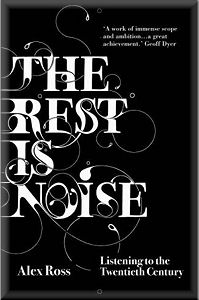
A
candy bar for musicologists, but perhaps too much meat and not
enough potatoes for average music lovers.
For me, this book was a real page turner;
I read the 543 pages at lightning speed in two days. The style
is lucid, expansive, relaxed, at times hilariously witty, pretty
much like the best of Alex Ross’ commentaries published in New
Yorker magazine, from which much of this book comes. I learned
an awful lot I didn’t know; but then I’ve spent 56 years building
up the background: I’ve spoken to Darius Milhaud, Lukas Foss,
Wilhelm Kempff, Russell Oberlin, and Karlheinz Stockhausen,
heard Stravinsky conduct (magnificently) his Symphony of
Psalms, been lectured to by Tikhon Khrennikov and Blas Galindo
via interpreters, twice heard Glenn Gould in concert1,
saw Andre Previn, Pierre Boulez, and Simon Rattle conduct before
anybody else had ever heard of them. So for me this book was
bar gossip, home movies; whereas the average music lover might
find it quite a bit of an overload. Whereas I can check it out
of the library and read it through like a paperback novel, the
average music lover might better buy the book, read twenty pages
a day, then read it again — and again. And, beg, borrow, and
buy about a thousand CDs to listen to. In spite of laments on
the death of classical music, I think just about every piece
of music Ross discusses here is available on CD.
The book’s greatest weakness is that it
is, and reads like, a collection of essays and reviews, carefully
fitted together, but nonetheless selective, variable, with enormous
lacunae. The long chapter on the musical politics of Adolf Hitler
is a masterpiece of reporting. Ross’s very extensive, perceptive,
penetrating comments on Richard Strauss, Arnold Schoenberg,
Benjamin Britten and Pierre Boulez amount to drafts for psychological
biographies. But Edward Elgar gets two sentences and of Gustav
Holst, Ralph Vaughan Williams, and Alan Hovhaness there is not
a single word, merely their names listed in passing. Thus
three of the most popular, powerful and influential composers
of the 20th century are totally ignored. The omission
of Hovhaness is particularly crippling since Ross otherwise
writes extensively on the origins of minimalism, at least as
seen from New York and, occasionally, San Francisco; how can
he ignore the originator of it? And, Bohuslav Martinů was
using technique in the late 1950s. Black American composers
are extensively chronicled. There are entirely too many mentions
of jazz and blues; the author runs out of adjectives and starts
repeating himself; there just isn’t that much to say, but he
says it anyway. While he refers obliquely to the idea of 20th
Century American women classical musicians, and does say some
good things about Ruth Crawford Seeger, he is totally silent
about Marga Richter, Peggy Glanville-Hicks, JoAnn Faletta, Sylvia
Marlowe, Elinor Remick-Warren, Rebekah Harkness, Rosalyn Tureck,
Ina Ray Hutton, Olga Samarov and Lilian Fuchs. Then he extensively
praises women blues singers by name. The bit of badinage in
the title suggests that this book is intended as a compendium,
while this is just not true.
Ross’s rhetoric varies oddly. Where he
skewers Copland and Poulenc over and over with the word gay,
for Benjamin Britten3 and John Cage he only briefly,
discretely remarks on a “companion” and never registers the
tiniest hint about Barber, Cowell, Diaghilev, Menotti or Gershwin.
This further suggests that these essays were written at different
times under different circumstances for different audiences,
and leaves one to wonder what else has been slanted or left
out.
What hasn’t been left out is politics.
If you are an Ann Coulter fan or an unreconstructed Reagano-Friedmanite
you’d best avoid this book; you’d just have to tear it into
pieces and then smash half your CD collection. The important
part played in American music throughout the 20th
century by left-liberal individuals and institutions is well
documented. Although American composers went hungry at home,
in Europe the CIA, having decided that tonal music á la
Shostakovich was all Stalinist propaganda, poured millions of
American taxpayers’ dollars into promoting serial composers,
concerts, and music festivals in the idea that twelve-tone composing
was expressive of freedom and promoted democratic capitalism,
to the dismay of democrats as well as capitalists. Will Boulez
in his memoirs tell us what it felt like to be a CIA operative?
The pictures are about a third familiar,
but the remaining two thirds are new, new. Mahler smiling?
Who ever would have thought it.
Ross can’t quite make Theodore Adorno into
a thoughtful human being but he tries. His comments on Elliot
Carter are, for a New York critic, remarkably acerbic, not the
effulgent, effusive pæan one usually gets. But I challenge one
comment of his: On page 515 he says “…young audiences crowd
into small halls to hear Elliot Carter’s string quartets ….”
I challenge Mr. Ross to substantiate that statement, quote me
some sources, some ferinstances. I don’t think he can. I don’t
think anybody of any age flocks to listen to Carter string quartets,
not even in New York. I assert that this is pure Manhattanist
propaganda. Our local university music school finally did buy
the Carter quartets CD and so far I’m the only person who’s
checked it out. I really tried to like it — again — but got
nowhere, as I have for the last 40 years. If Elliot Carter has
ever written any music I have yet hear to hear it2;
I find more to applaud in Richard Nanes.
1 The last time at a concert his official
biography says never occurred.
2 An exception may be his early piano sonata
which I found worth a half-dozen hearings.
3 His extensive comments on Britten’s alleged
compulsion to friendship with “underage” boys makes it even
curiouser that he avoids the “g” word.
Paul Shoemaker