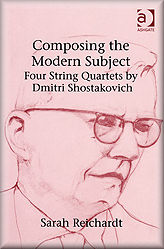
This
is one of those books which make you raise your game when it
comes to thinking about music in general, and the string quartets
of Shostakovich in particular.
Sarah Reichardt is an Assistant Professor of Music at the University
of Oklahoma, and with this book she presents an in-depth analysis
of the quartets nos. 6, 7, 8 and 9. Although this might seem
to be a restricted selection, in fact it allows Reichardt to
focus on as many of the significant aspects of Shostakovich’s
entire output for the medium. These four middle quartets make
up an entirely satisfying set, with the 9th quartet
leaning on structural elements of those preceding. The breadth
of expression covered by these four works also pretty much covers
the emotional and technical spectrum of the entire canon of
the quartets, and I have found myself listening to the pieces
not included in the book in a way which is coloured by many
of the references and analyses made here.
Solomon
Volkov’s memoirs of Dmitri Shostakovich are mentioned in the
blurb to this book, and part of the aim of Reichardt’s analyses
and comment is to set aside a biographically grounded approach
and avoid the controversy this has caused over the years. In
doing this, she does however lay down a potential bed of nails
– we may appreciate this different angle, but are posed with
numerous points on which agreement or disagreement will undoubtedly
create their own level of argument. This stimulation of discussion
is no bad thing of course, but as I learned in the dim and distant
days of my own education in this field, it is almost never correct
to take anything for granted.
As
a general comment, this book is not a particularly easy read.
My own experience of musical analysis is now clearly hopelessly
out of date, since the language used by Reichardt had me flicking
towards the end in search of a glossary almost straight away.
I am by no means suggesting that such writers should ‘dumb down’
and am more than willing to put up my own hand in pleading appalling
ignorance. Being sent scurrying to look up words like ‘hermeneutic’
and ‘epistime’ however, and swallowing sentences such as ‘The
idea of an ungraspable entity that affects discourse is one
elucidated by the Lacanian psychoanalytical concept of the “real.”’,
may give readers some idea of the kind of intellectual hoops
one is asked to negotiate. To be fair, Reichardt fully explains
each of her analytical bases, and working through and comprehending
each argument is both educational and rewarding in terms of
an appreciation of the quartets. It does however mean that ‘dipping’
into the book and expecting to glean little nuggets of information
which you can slip casually into your next music appreciation
meeting are pretty much out. Unless you are uncommonly well
informed on the subject, you will need to prepare the foundations
for each analysis by reading in much the same way the author
did when writing the book.
The
Lacanian theoretical approach is central to Reichardt’s analysis.
Without going into detailed explanations and lengthy quotes,
this means looking at the problems posed by the music in terms
of symbolism which grows out of the ‘real’ and ‘imaginary’ realms.
Taking the well known Eighth String Quartet as an example, we
have the ‘moniker’ of that all-embracing DSCH motive, plus what
Reichardt describes as the ‘musical ghosts’ or quotations from
other works. Reichardt discusses the problems of finding a meaning
in the DSCH motive, and concludes that it acts as a power for
summoning the aforementioned quotations – giving them added
power in terms of what they signify; ‘in hopes of conjuring
up the identity of the subject so that the sign of absence may
be filled by their presence.’
With
this mapped out as a viewpoint for the entire quartet, the work
is seen in terms of Death, as ceremonial, in terms of the physical
actions of a Dance or a March, and as a Funeral Lament. While
five chapters with the words ‘death’ or ‘funeral’ in the title
might seem a bit doom-laden and one sided, Reichardt provides
convincing arguments for all of these aspects of the work using
extensive references both musical and as sourced from other
comments both literary and analytical. These references are
both specific to the work and incidental in terms of the philosophy
and external themes applied to the discussion. Reduced to a
nutshell, the Sixth String Quartet is analysed in terms of endings:
‘Cadences and Closure’, the importance of the coda is an important
element in Rechardt’s approach to the Seventh, and the Ninth
is viewed in terms of ‘Novelization’, showing how it builds
on the previous quartets to create its own narrative. The full
title of each chapter give some clues: The end that is no
end: cadences and closure in the 6th string quartet, Op.101
(1956); The space between: codas, death and the 7th string quartet,
Op108 (1960); Musical hauntings: the ritual of conjuration in
Shostakovich's 8th string quartet, Op.110 (1960); The indivisible
remainder: novelization in the 9th string quartet, Op.117 (1964).
While
stimulated, but also somewhat staggered by all of this bracing
and breathtaking intellectual discourse, I always had a no doubt
naïve thought nagging at the back of my mind. As a composer,
I know something about the personal symbolism of certain ‘moments’
in music. These have a certain fixed character, but only in
terms of time. They will have a particular meaning when the
music is discovered and written, but will adapt and change as
the life of the composer and that of the piece itself proceeds
and is altered by time. For me it is almost impossible to take
an objective view and apply retrospective symbolic analysis
to any of my own pieces, so I therefore also find it problematic
when applying it to other composers or specific works. It is
certainly educational to find out about the spider’s web of
thematic reference and relationships which go towards creating
the consistently enigmatic world of Shostakovich’s string quartets,
but without the clearly impossible added equation of the composer’s
own answers to these questions, we can only apply external interpretation
and use best evidence to back up our viewpoint. This Reichardt
does superlatively well, and I’m not suggesting that she is
imposing a fait accompli on this or any of the other
quartets, but I would defend to the death anyone capable of
finding and supporting an argument for the Eighth String Quartet
as an affirmation of life. No, I’m not saying it would be correct,
I’m just saying that one’s own feelings and views shouldn’t
necessarily be discounted as invalid when set against the strength
of any analysis, however forceful and convincing its argument.
Sarah
Reichardt’s strength is that, even after all of this detail
and definition, she is prepared to admit to the unknowable in
these pieces. Her opening sentence mentions an underlying theme
of the book as ‘the inability of linguistic discourse to fully
articulate the whole of our lived experience.’ In the final
pages she allows for ‘this ungraspable entity… of which we can
only catch glimpses through the many facets of interpretation.’
In the final summing up, she admits to the work of Shostakovich
as, at least in part, standing ‘a witness for the citizenry
of the Soviet State.’
This
detailed and fascinating exploration of the musical ambiguities
of these string quartets turns out to be one of those books
which you will want to take with you on holiday. Equipped with
recordings and a restful environment, you’ll appreciate the
kind of time and space with which to immerse yourself in Reichardt’s
intense and demanding, but ultimately highly rewarding world.
There are plenty of score fragments illustrating the most important
musical events, but having a complete study score to hand always
helps – not so much in terms of the content of the book, but
so you can identify for yourself the re-appearance and transformation
of ideas already illustrated. 129 pages may not seem like much,
especially when many of those are taken up with indexes, references,
musical quotes and bibliography, but don’t be fooled – the type
is quite small, and there is more than enough to get your mental
teeth into. Reichardt’s research and writing not only confronts
us with elements in the music which reveal the constant flux
of the ‘modern subject’ in Shostakovich, but also reflects pathologies
endemic to the modern condition through the application of psychoanalysis.
Knowledge is strength, and even if it becomes the cause of debate
either internal or in company, it can still only strengthen
our appreciation of these incredible pieces.
Dominy Clements