Editorial Board
MusicWeb International
Founding Editor Rob Barnett Editor in Chief
John Quinn Contributing Editor Ralph Moore Webmaster
David Barker Postmaster
Jonathan Woolf MusicWeb Founder Len Mullenger
John METCALF (b.
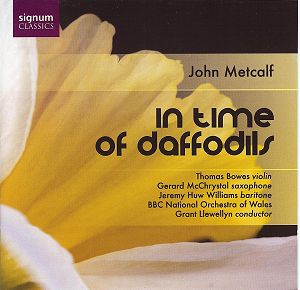
1946) Paradise Haunts ... (1995, orch. 1998) [25:13] Three Mobiles (2001, rev. 2003, 2006)[14:10] In Time of Daffodils (2006) [27:06] Thomas Bowes (violin: Paradise) Gerard
McChrystal (saxophone: Mobiles)
Jeremy Huw Williams (baritone: Daffodils)
BBC National Orchestra of Wales/Grant Llewellyn
rec. Brangwyn Hall, Swansea, Wales, 20-21 December 2006
Texts included SIGNUM SIGCD103 [66:31]
The
title of Metcalf’s Paradise Haunts ... is drawn
from a line quoted in a book about film-maker Derek Jarman: “Paradise
haunts gardens and it haunts mine”. The composer came across
this when reading a review at about the time Thomas Bowes -
the soloist here - asked Metcalf for a new piece. The composer
also mentions that he started work on the piece at a time when
he felt the urge to simplify his musical language. Paradise
Haunts... was “the first work to embrace a wholly pan-diatonic
or ‘white note’ style”. This substantial work, a rhapsody in
the form of a theme and variations, was originally written
for violin and piano. Incidentally, the original chamber version
has been recorded and is still available on Lorelt LNT111.
The orchestral version was made some time later, in 1998. Variations
unfold almost effortlessly and seamlessly, with enough contrast
and variety to sustain the work’s long time-span. It concludes
with a beautiful coda in which the music eventually dissolves
into thin air. The music, as in the other works of Metcalf,
is often warmly melodic and lyrical as well as strongly expressive.
In the case of this particular work, I was often reminded of
Barber’s Violin Concerto, which does not imply imitation but
rather hints at the general tone of the music. A fine, accessible
work, albeit steeped in tradition - by 20th century
standards - although the solo part must be rather demanding
both in technique and in musicality.
Similarly, Three
Mobiles started out for saxophone and piano. The
orchestral version, actually for string orchestra, was
made in 2003 when the work was revised. A further revision
was made in 2006. The title refers to sculptures known
as mobiles - Calder’s celebrated mobiles are an example.
In the insert notes, the composer goes into some detail
as to how he tried to relate his musical mobiles with those
of Calder. The most important thing, however, is the music,
although I suppose that close analysis of the score might
prove revealing. Suffice to say that in substance Three
Mobiles is a concertino for saxophone and strings.
It consists of two short, lively outer movements framing
a rather more developed, predominantly song-like central
movement. Again a quite attractive work that should appeal
to saxophone players willing to add to their sadly limited
repertoire.
Like
the other works here, In Time of Daffodils started
life as a short song-cycle for baritone and piano. It sets To
Daffodils (Herrick), Daffodils (Wordsworth) and To
an Early Daffodil (Amy Lowell). In the meantime, however,
BBC Radio 3 commissioned an orchestral work to mark the composer’s
60th birthday. He felt that a more substantial song
cycle was possible and went on to choose three further poems: The
Lent Lily (Housman), the Prologue to Endymion (Keats)
and another poem by Amy Lowell (White and Green). Not
content with this, he re-arranged his settings into two main
parts separated by a short orchestral interlude. As if to emphasise
the overall symmetry, each of the two parts is centred around
a longer setting framed by shorter ones. The plan of the work
is thus:-
Part
I : The Lent Lily, Daffodils, White and Green;
Interlude;
Part
2 : To Daffodils, Endymion, To an early Daffodil.
Most
of the poems are fairly well-known, although I must admit that
those by Amy Lowell were new to me. All relate to Spring symbolising
death and renewal, although the celebrated prologue to Endymion has
a more general meaning. Again, Metcalf’s settings are fairly
traditional, in the best meaning of the word, and the words
come clearly through the warm, at times lush but always subtle
scoring. The music is colourful, superbly scored and – again – attractive
and accessible without condescension. While listening to this
beautiful work, I often thought that this was the large-scale
orchestral song-cycle that John Ireland never composed. Frankly,
I mean that as a compliment.
These
performances will not easily be bettered. Everyone sings and
plays with conviction and commitment; and the whole is warmly,
yet naturally recorded - a real pleasure from first to last.
Hubert Culot
Please support our advertisers below by clicking on the logos for further information.

























 Thomas Bowes (violin: Paradise) Gerard
McChrystal (saxophone: Mobiles)
Jeremy Huw Williams (baritone: Daffodils)
Thomas Bowes (violin: Paradise) Gerard
McChrystal (saxophone: Mobiles)
Jeremy Huw Williams (baritone: Daffodils)