Editorial Board
MusicWeb International
Founding Editor Rob Barnett Editor in Chief
John Quinn Contributing Editor Ralph Moore Webmaster
David Barker Postmaster
Jonathan Woolf MusicWeb Founder Len Mullenger
Buy
through MusicWeb
for £11.00 postage
paid World Wide. Try
it on Sale or Return You
may prefer to pay by Sterling cheque or
Euro notes to avoid PayPal. Contact
for details
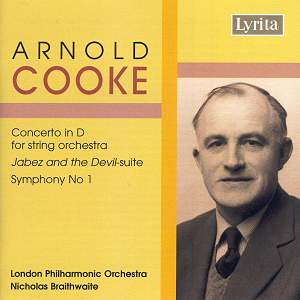
Arnold COOKE (1906-2005)
Concerto in D for string orchestra (1948) [16:07]
Symphony No. 1 (1947) [36:40] Jabez and the Devil - Suite (1959) [18:02] London Philharmonic Orchestra/Nicholas
Braithwaite
rec. 1974, 1988, 1989. ADD LYRITA SRCD.203 [70:53]
Two of these three recordings are newly released.
The odd man out is Jabez and the Devil, the 1959 ballet
suite, which was released on vinyl on Lyrita SRCS78 back
in 1974. The Symphony was recorded in 1989 and the Concerto
in D the year before but they’ve been resolutely unreleased
ever since and thus make a very welcome if blinking-into-the-light
appearance all these years later.
The Concerto was written in 1948 and is cast in
three movements. Its neo-classicism is wonderfully vibrant
and undogmatic, loose-limbed and exciting. There’s a strong
role for solo violin and witty roles also for the other string
principals – with a democratic generosity that does Cooke
honour. There’s plenty of badinage in this kind of writing
and certainly too a nod in the direction of Stravinsky and
principally Hindemith. The cool dark grain of the slow movement
is lit by austere candlelight but the beauty of the writing
is never obscured. Similarly the high-spirited finale is
energetic and propulsive. It brings to a close a work of
exuberance and warm generosity.
The First Symphony predates the Concerto by a
year. For a few disconcerting seconds it feints toward pastoral
but this is utterly deceptive because the influence of Hindemith
asserts itself strongly. The brass is mordant, the strings
fly high and the tension generated holds the whole thing
on a tight rein. The scherzo is unusually attractive and
urgent, led pungently and once more wittily by the winds.
The strings turn ironic and the brass proves fulsome, with
a strong role for the first trumpet. Noble gravity announces
the slow movement with its reserved eloquence coming through
powerfully in this performance as well as some stalking baroque
figures in the string section. We end with an affirmative,
brisk and avuncular finale and Cooke is keen and successful
in infusing colour and rhythmic variety into the writing.
The suite consists of some varied and engaging
dances – variously devilish, rustic and even off-kilter with
wicked Saint-Saëns moments in the Fiddle Polka and
some cackling spit, abetted by cracking brass elsewhere.
Hear the Stravinskian echoes in the Percussion Dance as
well.
To the old and the new a real welcome. This Cooke
triptych has plenty of variety and vitality and is splendidly
played and recorded and notated. Does Cooke have an austere
profile these days? Assuredly not if you listen to these
works.
Jonathan Woolf
























 for details
 London Philharmonic Orchestra/Nicholas
Braithwaite
London Philharmonic Orchestra/Nicholas
Braithwaite