This was a set of the
symphonies that, like Bryden Thomson’s,
I’d not really got around to. The single
discs as above are also available in
a box set and it’s been a pleasure to
listen to them, not least for some of
the best recorded Martinů
symphonies on disc. I won’t hedge my
bets – clearly specialists will pick
and choose individually – but I will
say that you won’t be at all disappointed
listening to this cycle and you will
gain a great deal from the clarity,
acumen and sheer intelligent
level-headedness of Järvi’s conducting.
If that sounds like a backhanded compliment
it’s not meant to.
If you have or can
find Claus Peter Flor’s Berlin Symphony
RCA Red Seal recordings of the earlier
symphonies, almost contemporaneous with
these, you may wonder what the differences
are between them. In terms of tempo
not much; in terms of orchestral excellence
very little but Järvi has the better
sound and also slightly the better of
the musical argument. In the First Järvi
is the more convincing in terms of tempo
contrasts whereas Flor makes much of
the sometimes dramatic dynamic gradients
in the music – sometimes it has to be
said a little too much. Flor indeed
treats the whole opening of the symphony
as a sustained orchestral crescendo
whereas Järvi admits of a degree
more ambiguity. When it comes to the
Second Järvi is more forward moving
than his German rival and once again
– a feature of their divergence - doesn’t
observe the steep dynamics that Flor
cultivates. Overall however Järvi’s
sense of colour is slightly the more
convincing in the winning Second. Of
the Third I find that he brings out
the motoric writing well – as well as
the latent power – and evokes the string
choirs, chaste but full of tension,
with exemplary understanding. He moves
forward well and only when he makes
an unmarked rit in the finale did I
seriously part company with him. Turn
to Ancerl however and one finds a different
kind of Martinů
conducting – one that mines a vein of
melancholy that younger musicians seldom
do. At a much slower tempo in the Largo
Ancerl is almost Brucknerian in his
depth and his orchestral palette is
that much more spectral and fearful
than any other conductor has
ever dared it to be.
In comparison with
Vaclav Neumann in the Fourth (editor
Rob Barnett swears by the Turnovsky
1970s reading by the way, which I’ve
not heard) one finds that Järvi
takes sensible tempi without extremes.
His climaxes tend to be more abrupt
than the Czech conductor’s and Neumann
tends to coalesce orchestral material
more levelly. I liked Järvi’s Largo,
which is long breathed and notably well
played but Neumann – a distinguished
string player in his youth of course
– does sustain the lyrical tension that
bit better. As recorded sound goes though
the Bamberg recording is significantly
better. In the great Fifth Symphony
Järvi’s is a fine and perfectly
convincing statement. He tightens the
tension from 5.20 in the first movement,
and he brings out the folk writing well
in the Larghetto. If the trumpet theme
at 5.18 sounds a little static it’s
really only in comparison with a titan
like Ancerl that we really notice. Everything
in Ancerl’s performance is that much
more complex and etched. The animation
of the rustic music is more sharply
profiled, the string phrasing is more
affectionate and cantilevered with more
delicacy and at a significantly faster
tempo Ancerl gives a greater sense of
musical direction. Not that Järvi
is poor, not at all, just that the movement
falls into place more securely and all-embracingly
in Ancerl’s hands. In the finale Järvi
is exultant and driving and Ancerl full
of natural momentum – though the latter’s
strings aren’t flattered here by the
recording, sounding a bit glassy. I
liked Järvi’s Sixth. There’s a
fresh air approach and plenty of fluctuating
rhetoric in the opening movement. In
the Poco allegro second movement Ancerl
evinces a taut and invincible control
whereas Järvi sounds rather abrupt
and is inclined to make less of the
contrasts – though they take essentially
the same tempo. What really separates
them is one of those things you recognise
when you hear it – the Czech conductor’s
ability to turn corners in lyrical incident.
There’s always a sense of tactile life
in his conducting. To simplify their
final movements rather I’d say that
that Ancerl is darker and more uneasy,
especially in the stabbing martial moments
– and also slightly tauter – whereas
Järvi is more romantic and benign.
I lean to Ancerl but one can’t deny
the Bamberg precision or sense of demonstrable
commitment.
So not necessarily
a first choice set then. Many will already
have adherents for individual symphonies
and many of the great recordings (Ancerl’s,
Munch’s of the Sixth both commercial
and off-air) will be on collectors’
shelves. But for the inquisitive new
comer who wants a well documented, brilliantly
recorded, excellently played and broadly
sympathetic set of readings this Järvi
set has many points in its favour. I
liked it and I recommend it.
Jonathan Woolf
se also review
by Rob Barnett
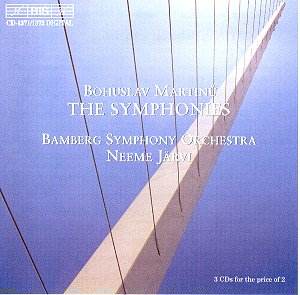
 Bamberg Symphony Orchestra/Neeme Järvi