A
tremendous SACD. These are classic Berlioz readings under
the baton of a master. Although the playing time is only a
smidgen over an hour, the sheer involvement of the players
and the super-clean recording makes this an exhausting listening
experience.
Not
only is the recording super-clean, it is also rather up-front;
as was Living Stereo's way. That said, the way the strings
are captured is exquisite, something reflected in their loving
phrasing. When the tempo and dynamics increase, ensemble is
outstanding, as is the sheer energy the orchestra injects
into the score. It is easy to hear the supernatural/magical
element that inspired the composer to these heights.
Some
of the string writing here in the first movement is notorious,
and it is to the Boston Symphony's credit that they are simply
jaw-dropping at these difficult corners; the section excels
again in the 'March to the Scaffold'. The really close
harp of the second movement may distract, but interestingly
the impression left by this 'Ball' is of an underlying tenderness.
Perhaps
there is understandable fear to the cor anglais solos of the
country scene, but the objection to this movement is that
it is just a tad fast to make its full atmospheric effect.
Yet as the movement proceeds one is aware of Munch's intensity;
this is preferable to Colin Davis in any incarnation. The
solo timpani rolls towards the end of the movement are almost
unbearably lonely.
Berlioz's
pictorialism clearly appealed hugely to Munch; the finale
(Witches' Sabbath) is hugely exciting. It is difficult not
to wonder if Solti based his interpretations on those of Munch.
Certainly, much of the same energy is there, but without Munch's
depth and clear affinity with the music.
The
filler is a stunning Love Scene from Op. 17. Munch
has the Bostonians spin a delicate web of sound in a reading
that is at once expansive and tender.
A
de luxe issue. The low playing time hardly matters – this
is Berliozian gold.
Colin Clarke
BUY NOW
AmazonUK
AmazonUS



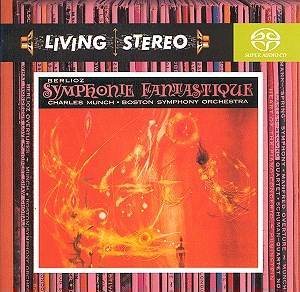
 Boston Symphony Orchestra/Charles Munch
 [60:11]











